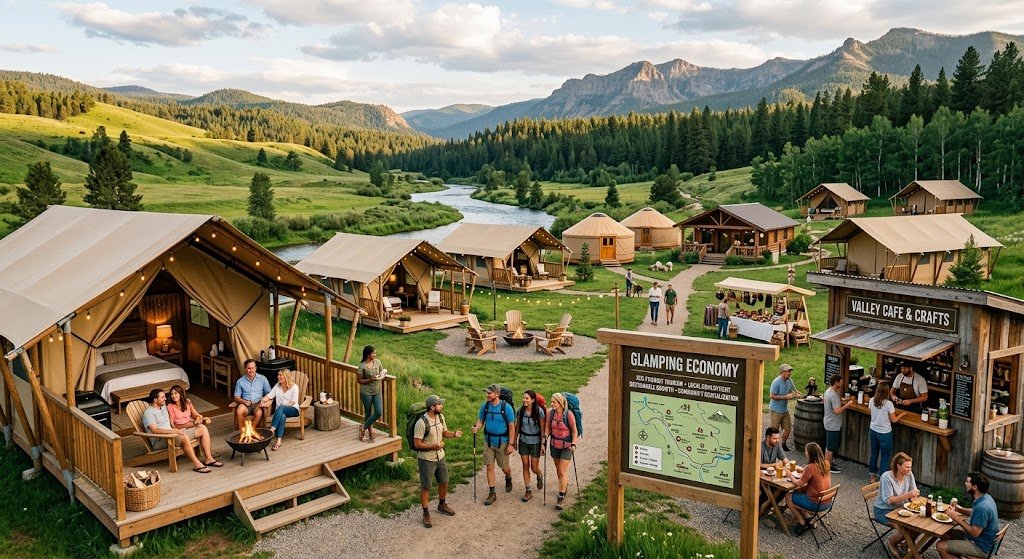

The Glamping Economy is becoming a serious segment of global hospitality. What began as a niche alternative to traditional camping now sits at the intersection of experiential travel, outdoor hospitality, eco-tourism, wellness tourism, short-term rentals, and boutique accommodation. Travelers still want mountains, forests, deserts, lakes, and open skies. They simply do not always want sleeping bags, communal bathrooms, or the work associated with conventional camping.
That shift is creating an increasingly sophisticated commercial ecosystem. Glamping businesses now range from individual safari tents and geodesic domes to professionally managed resorts featuring private bathrooms, climate control, restaurants, hot tubs, guided activities, wellness programs, and hotel-grade guest services.
The numbers explain why investors and hospitality operators are paying attention. Grand View Research valued the global glamping market at approximately $3.8 billion in 2025 and estimates it could reach $7.9 billion by 2033, representing a 9.5% compound annual growth rate from 2026 through 2033.
Yet market size tells only part of the story.
The real opportunity is the economic model developing around the accommodation itself.
What Is the Glamping Economy?
The Glamping Economy encompasses the businesses, infrastructure, services, technology, labor, experiences, and local spending generated by upscale outdoor accommodation.
Traditional camping primarily monetizes access to a campsite. Glamping monetizes a much broader experience.
A guest might pay for a beautifully designed dome overlooking a valley, then purchase breakfast, a guided hike, firewood, a private sauna session, equipment rental, transportation, locally produced food, or a wellness treatment. That creates multiple layers of economic activity from one overnight stay.
The ecosystem can include:
- Safari tents, yurts, domes, cabins, pods and treehouses
- Landowners and property developers
- Outdoor resort operators
- Architects and modular accommodation manufacturers
- Booking platforms and online travel agencies
- Property-management software providers
- Housekeeping and maintenance services
- Restaurants and food suppliers
- Tour guides and outdoor recreation businesses
- Wellness providers
- Local artisans and retailers
- Transportation operators
- Renewable-energy and off-grid infrastructure suppliers
This distinction matters. Measuring only room revenue can substantially underestimate the broader value created by an outdoor hospitality destination.
How Big Is the Glamping Economy?
Market estimates vary depending on how researchers define glamping, but the direction is clear: the category is expanding.
Grand View Research estimates that the global market will increase from approximately $4.2 billion in 2026 to $7.9 billion by 2033. Europe represented 35% of global revenue in 2025, while cabins and pods accounted for 43% of the accommodation market. Travelers aged 18–32 represented the largest age segment at 43.9%.
The surrounding outdoor-hospitality market is much larger.
Kampgrounds of America’s 2026 Camping & Outdoor Hospitality Report found that more than 52 million North American households camped during 2025, generating an estimated $66 billion economic footprint.
Historical KOA research also demonstrates why glamping deserves attention as a distinct economic category. Its North American Glamping Report found that nearly 17 million households took a glamping trip in 2021, representing a 155% increase compared with 2019. The same research reported that glampers spent 45% more in local communities than conventional campers.
That spending multiplier is important.
A successful glamping destination does not merely sell somewhere to sleep. It can become an anchor for a small visitor economy.
Why the Glamping Economy Is Growing
Several structural changes in travel are converging at once.
1. Travelers Want Nature Without Sacrificing Comfort
Conventional camping creates friction.
Guests may need tents, sleeping equipment, cooking gear, outdoor knowledge and tolerance for unpredictable weather. Glamping removes much of that friction while preserving the emotional appeal of sleeping close to nature.
A comfortable mattress changes the addressable market dramatically.
Couples who would never book a primitive campsite may happily reserve a climate-controlled dome with panoramic windows and a private bathroom. Families can enjoy an outdoor trip without purchasing specialized equipment. Older travelers can participate without accepting the physical inconveniences associated with basic camping.
The result is a much broader customer base.
2. The Accommodation Has Become Part of the Attraction
Hospitality traditionally follows destination demand: travelers choose a city, beach or attraction and then find accommodation nearby.
Unique outdoor stays can reverse that sequence.
The property itself becomes the reason to travel.
Airbnb’s historical research into unique stays demonstrated this behavioral shift particularly clearly. It reported substantial growth in searches for yurts, huts, farm stays and other unusual properties, while treehouses, tiny houses, cabins and domes featured prominently among highly wishlisted homes.
That dynamic changes location economics.
A conventional hotel generally benefits from being close to established demand generators. A remarkable treehouse, transparent dome or desert camp may create its own demand if the setting, design and experience are sufficiently distinctive.
3. Social Media Rewards Visually Distinctive Properties
Glamping is unusually compatible with visual discovery.
Picture a transparent dome beneath the stars. A cedar hot tub overlooking snow-covered mountains. A suspended treehouse surrounded by forest. A canvas safari tent illuminated at sunset.
These environments naturally produce content.
That gives well-designed properties something conventional accommodation often struggles to achieve: guest-generated organic distribution.
Every Instagram Reel, TikTok video, YouTube vlog, Pinterest save and Google review can become part of the property’s acquisition engine. Architecture therefore serves two purposes. It creates guest value and can reduce dependence on paid advertising by making the accommodation intrinsically shareable.
This is why design should not be treated merely as a construction expense. In the Glamping Economy, distinctive design can function as a marketing asset.
The Business Model Behind Glamping
A glamping operation sits somewhere between a campground, boutique hotel, vacation rental and experiential-tourism business.
That hybrid model creates interesting economics.
Accommodation Revenue
The nightly rate remains the core revenue stream.
Pricing depends heavily on location, privacy, structure type, seasonality, amenities, local competition and the strength of the property’s brand.
Operators should monitor average daily rate (ADR), occupancy, RevPAR, average length of stay, cancellation rate and contribution margin, rather than focusing exclusively on bookings.
High occupancy can look impressive while producing poor returns if rates are heavily discounted or operating costs are excessive.
Ancillary Revenue
This is where sophisticated operators can materially increase guest value.
Potential add-ons include:
- Breakfast baskets and meal packages
- Private hot tubs or saunas
- Firewood and campfire kits
- Bicycle, kayak or paddleboard rental
- Guided hikes and wildlife experiences
- Yoga and meditation sessions
- Stargazing experiences
- Photography packages
- Romantic celebration packages
- Airport or station transfers
- Local wine or food tastings
- Merchandise and locally made products
A useful metric is total revenue per occupied unit, not merely room revenue.
If a $250 booking generates another $80 through food, activities and wellness services, the underlying economics look very different.
Why Direct Bookings Matter to the Glamping Economy
Distribution strategy deserves far more attention than it typically receives.
Grand View Research estimates that direct bookings represented 54.7% of the global glamping market in 2025.
Direct demand can be strategically valuable because operators gain greater control over customer relationships, remarketing, packages, loyalty programs and transaction economics.
That does not make online travel agencies unnecessary.
Platforms can provide enormous discovery value, particularly for new properties without established brands. A sensible strategy is often to use third-party marketplaces for customer acquisition while simultaneously building a strong direct-booking engine through SEO, email marketing, branded search, social media, repeat-guest campaigns and referral programs.
The objective should not simply be “more bookings.”
It should be profitable demand diversification.
Glamping Economy Unit Economics: What Investors Should Measure
Beautiful accommodation does not guarantee a viable hospitality business.
Before developing a site, investors should model the operation at unit level.
Consider a hypothetical property with 15 units charging an average nightly rate of $240.
At 55% annual occupancy:
15 units × 365 days × 55% occupancy = approximately 3,011 occupied unit nights.
Multiplying that by a $240 ADR produces approximately $722,640 in annual accommodation revenue before ancillary income.
That figure is not profit.
An operator still needs to account for payroll, cleaning, utilities, insurance, booking commissions, payment processing, repairs, linens, marketing, software, property taxes, waste management, financing costs and eventual replacement of structures and furnishings.
The most important metrics include:
- ADR: average revenue earned per sold unit
- Occupancy rate: percentage of available nights sold
- RevPAR: revenue per available unit
- CAC: customer acquisition cost
- Ancillary revenue per stay
- Labor cost per occupied unit
- Maintenance cost per unit
- Guest acquisition channel mix
- Repeat-booking rate
- Net operating income
- Payback period on development capital
This financial discipline separates an attractive property from a durable hospitality asset.
Glamping and the Experience Economy
The strongest operators understand a fundamental point: guests are not buying tents.
They are buying stories, memories, privacy and access to place.
That moves glamping squarely into the experience economy.
A generic dome beside a parking lot has limited differentiation. Put the same structure beneath a dark-sky reserve, integrate local cuisine, create a guided astronomy program and provide private outdoor bathing, and the perceived value changes dramatically.
Experience design can therefore create pricing power.
The question operators should ask is not:
“What amenities should we add?”
It is:
“What experience could guests only have here?”
That question produces stronger products.
Sustainability: Opportunity and Operational Challenge
Glamping is frequently marketed as sustainable tourism because some structures can have smaller footprints than conventional resort buildings. But small does not automatically mean sustainable.
Operators must examine the entire system.
Water consumption, wastewater treatment, guest transportation, heating and cooling, land disturbance, biodiversity, food sourcing, waste generation and energy infrastructure all affect environmental performance.
Traveler expectations are rising as well. Booking.com’s 2025 sustainability research reported that 93% of global travelers wanted to make more sustainable travel choices, while 58% said they were actively changing their travel habits accordingly.
Credible practices may include solar generation, efficient insulation, low-flow fixtures, responsible wastewater systems, refillable toiletries, habitat restoration, local procurement, recycling and transparent sustainability certification.
Greenwashing is the wrong strategy.
Specific evidence is stronger than vague claims such as “eco-friendly luxury.”
How the Glamping Economy Benefits Rural Communities
One of the category’s most interesting features is geography.
Glamping can direct higher-value tourism expenditure toward rural regions that lack the density required to support large conventional hotels.
Guests need more than accommodation. They buy groceries, meals, fuel, tours, transportation, souvenirs and recreational services.
That creates potential demand for local:
- Farmers and food producers
- Restaurants and cafés
- Guides
- Craftspeople
- Cleaning teams
- Maintenance contractors
- Transportation providers
- Adventure-tourism companies
- Wellness practitioners
KOA’s earlier finding that glampers spent 45% more in local communities than standard campers illustrates why local economic impact deserves consideration alongside room revenue.
However, local benefit is not automatic.
An isolated resort importing its workforce, food and services may capture most expenditure internally. Operators seeking genuine destination impact should intentionally develop local procurement and partnership networks.
The Biggest Risks Facing the Glamping Economy
Rapid growth can hide weak fundamentals.
Planning and Regulation
A tent may look temporary. Regulators may not treat it that way.
Operators can encounter requirements involving zoning, building codes, fire safety, accessibility, wastewater, food service, environmental protection, parking and short-term accommodation licenses.
Land should never be purchased based solely on its appearance or asking price.
Regulatory feasibility comes first.
Seasonality
Outdoor accommodation is particularly exposed to weather.
Extreme heat, cold, rain, wildfire, storms and flooding can compress the revenue season or increase operating expenses.
Climate resilience is consequently becoming a financial issue, not simply an environmental one. Booking.com’s industry research indicates that travelers increasingly consider extreme weather when deciding where and when to travel.
Oversupply and Commoditization
A dome was once inherently novel.
It no longer is.
As similar properties enter the market, operators relying exclusively on unusual structures risk becoming interchangeable. Long-term differentiation will increasingly come from location, service, programming, hospitality, storytelling and brand reputation.
Operational Complexity
Guests may expect wilderness views and hotel-level reliability simultaneously.
That is difficult.
Remote properties still need spotless bathrooms, functioning Wi-Fi where promised, hot water, comfortable temperatures, responsive staff and dependable housekeeping. A spectacular location cannot compensate indefinitely for poor hospitality operations.
Where the Next Glamping Economy Opportunities May Emerge
The next stage of growth is likely to be more specialized.
Wellness glamping can combine accommodation with yoga, sauna, cold immersion, meditation and spa treatments.
Dark-sky tourism can turn remote locations into astronomy-focused destinations.
Farm and agritourism glamping can help landowners monetize landscapes while connecting guests with food production.
Corporate retreats can generate valuable weekday and shoulder-season occupancy.
Adventure hubs can package accommodation with cycling, hiking, climbing, kayaking or wildlife experiences.
Treehouses also demonstrate how individual accommodation niches can develop into meaningful categories. Grand View Research valued the global treehouse glamping segment at approximately $332.4 million in 2024 and forecasts it could reach $473.2 million by 2030.
The broader lesson is simple: specialization can protect pricing power.
How to Build a Competitive Glamping Business
Entering the Glamping Economy should begin with demand research, not buying structures.
A disciplined development process looks like this:
- Identify the target guest. Couples, families, wellness travelers and adventure tourists have different expectations.
- Validate demand. Analyze local ADR, seasonality, occupancy signals, attractions, competitor reviews and search demand.
- Verify planning feasibility. Understand zoning, utilities, wastewater, fire codes and environmental restrictions before committing capital.
- Model unit economics. Build conservative scenarios for occupancy, ADR, payroll, commissions and maintenance.
- Design a differentiated experience. Give travelers a compelling reason to choose the property rather than simply another dome or cabin.
- Build multiple revenue streams. Accommodation should anchor the business, not necessarily represent its only source of income.
- Develop direct demand. Invest in SEO, email, social proof, repeat guests and brand search while maintaining useful third-party distribution.
- Measure relentlessly. Track RevPAR, CAC, guest satisfaction, ancillary spend and contribution margin.
The best glamping properties are hospitality businesses first and attractive real estate second.
FAQ About the Glamping Economy
What is the Glamping Economy?
The Glamping Economy is the commercial ecosystem surrounding premium outdoor accommodation. It includes glamping resorts, independent hosts, landowners, booking platforms, structure manufacturers, hospitality workers, local suppliers, tour operators, restaurants, wellness providers and other businesses benefiting from guest expenditure.
Its economic impact therefore extends beyond the nightly accommodation rate.
How large is the global glamping market?
Grand View Research estimates the global market was worth approximately $3.8 billion in 2025 and projects it to reach around $7.9 billion by 2033, based on a 9.5% CAGR between 2026 and 2033.
Different research firms may produce different estimates because definitions and methodologies vary, so market forecasts should be treated as directional rather than guaranteed outcomes.
Is glamping a profitable business?
It can be, but profitability depends on occupancy, ADR, development cost, labor, seasonality, financing, distribution fees, ancillary revenue and operating efficiency.
A property charging premium rates can still lose money if construction costs are excessive or the usable season is short. Investors should build conservative unit-level financial models rather than relying on headline industry growth rates.
Why are travelers choosing glamping instead of hotels?
Glamping combines elements that hotels often struggle to deliver simultaneously: privacy, unusual architecture, direct access to nature and memorable experiences.
Guests can enjoy the emotional appeal of camping without sacrificing beds, bathrooms, electricity or other comforts. For many consumers, the accommodation itself also becomes an attraction worth traveling to.
What is the future of the Glamping Economy?
The market is likely to become more professional, segmented and competitive.
Growth opportunities should increasingly center on wellness retreats, regenerative tourism, premium cabins, dark-sky experiences, agritourism, adventure travel, corporate retreats and technology-enabled outdoor resorts. At the same time, generic properties will face greater pricing pressure as supply expands.
Conclusion: The Glamping Economy Is Moving Beyond the Tent
The Glamping Economy represents a deeper change in how travelers value outdoor experiences. People increasingly want nature, but many also expect privacy, design, comfort, dependable hospitality and experiences worth remembering.
That combination creates opportunities for landowners, hospitality companies, tourism operators, investors and rural communities. It also raises the standard for success.
Putting a luxury tent on attractive land is no longer enough.
Operators entering the market should validate demand, understand regulations, model unit economics, build climate resilience, develop local partnerships and create an experience competitors cannot easily reproduce.
Start with the guest and the destination. Then build the accommodation around them.
That is where the durable economic opportunity lies.