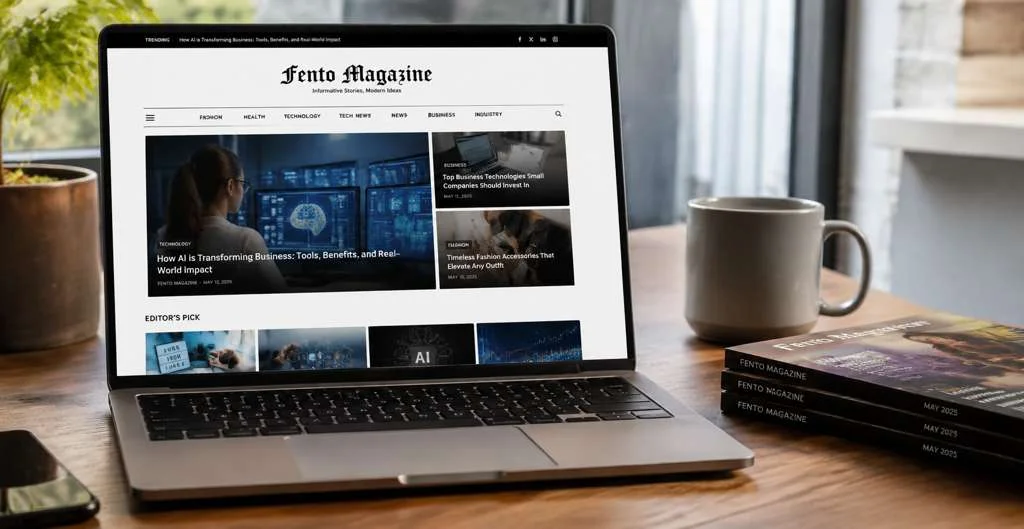

If you typed fentomagazine.com USA into a search bar, you are probably trying to answer a simple question. Is this an American magazine, a U.S. edition, or just the main website seen from an American search? The short answer is the last of those. Fentomagazine.com is the public site for Fento Magazine. The “USA” part of the query usually reflects location-based search intent, not a separate branded American edition sitting in the main menu.
That distinction matters before you judge the content, the tools, or the legal pages. A New York governing-law clause is not the same thing as a newsroom on a Manhattan floor. Readers in the United States can still open the site, browse articles, and use the social-media sections without a subscription. What they should not assume is a dedicated U.S. masthead that the public navigation does not currently show.
Quick answer for featured snippets
Fentomagazine.com USA is best read as a search phrase for Fento Magazine and its usefulness to readers in the United States. The publication’s own About page frames the brand around words, comments, opinions, and online conversations. The live site also publishes broader general-interest pieces and hosts caption and bio resources.
| Question | Plain answer |
|---|---|
| What site is it? | FentoMagazine.com, the main Fento Magazine website |
| Separate USA edition? | Not shown in current public navigation |
| U.S. legal note | Terms and privacy policies reference New York law |
| Core theme | Comments, opinions, and digital conversations |
| Extra sections | Instagram captions, bios, and a captions generator |
| Access | Public browsing, no paywall required to read |
What Fento Magazine says it covers
Fento Magazine describes itself as a place that treats comments as more than noise. On its About page, the publication says words carry weight, and that comments, opinions, and feedback shape how people see news, entertainment, culture, and each other. The stated vision is to decode public discussion rather than only repeat what someone posted.
That original brief still explains the site’s personality. Coverage interests listed by the publication include social-media reactions, celebrity and influencer commentary, news opinions, pop culture, internet trends, memes, and everyday online arguments. In practice, the homepage has also carried pieces on business, technology, home improvement, and other general topics. So the brand story and the current article mix are related, but they are not identical.
For a U.S. reader, that mix can be useful in two ways. First, you can treat the site as a casual reading destination. Second, you can use the caption and comment sections when you need wording ideas for a post. Neither use replaces a primary source when the topic is legal, medical, or financial.
Is fentomagazine.com USA a separate edition?
This is the point most people get wrong. A country name in a search does not always mean a country edition exists. Based on the site’s public structure, Fento Magazine runs through one main domain. There is no clearly labeled USA portal in the main navigation that would function like a standalone American magazine.
There is a separate legal detail. Public summaries of the Terms of Service and Privacy Policy note that New York, United States, is the stated governing jurisdiction, with disputes directed to New York courts. That is a contract clause. It tells you which law the site says applies to its terms. It does not, by itself, prove a physical headquarters, a U.S. newsroom, or a separately edited American issue.
Keep those two facts in different boxes:
- Confirmed from public pages: one main website, plus a New York law reference in the legal policies.
- Not established by those pages: a distinct Fento Magazine USA edition or a verified street address.
If you need an official location for a business filing or a press contact, use the Contact page and ask. Do not infer an office from a jurisdiction sentence.
How the site is organized
Navigation is straightforward. Visitors typically see Home, Comments, Instagram Captions, Instagram Bio, a Captions Generator, and Contact. Standard trust pages sit alongside those sections, including Privacy Policy, Terms of Service, Disclaimer, and About Us. The site is a WordPress-based publication, which is common for independent digital magazines.
Guest-post pitches are invited through the contact channel rather than through an open upload form on the homepage. That is normal. It also means acceptance is not guaranteed, and a published byline should not be treated as staff reporting unless the page says so.
| Section | What a reader can do with it |
|---|---|
| Comments | Read pieces built around reactions and public opinion |
| Instagram Captions | Browse caption ideas for posts and stories |
| Instagram Bio | Look at short bio lines and profile wording |
| Captions Generator | Produce draft caption options to edit |
| Contact | Send a question or a guest-post pitch |
| About and legal pages | Check the brand story, terms, and privacy notes |
Social tools versus editorial articles
The caption sections are the most practical part of the site for many visitors. A caption generator can save a blank-page moment. It will not know your brand voice, your audience, or the claim you should not make. Treat the output as a draft. Rewrite the line so it matches the photo, drop anything you cannot stand behind, and avoid copying a caption that already belongs to another creator.
The article side is wider. Recent public coverage has ranged across business, technology, law-related explainers, home topics, and digital culture. That breadth helps discovery. It also means quality can vary by page. A caption list and a piece on a technical subject should not be read with the same level of trust. Check dates, look for sources, and cross-check anything you might act on.
Who the site is actually for
Fentomagazine.com USA searches tend to come from a few groups.
Students and casual readers want a quick definition of the brand. Social managers want caption and bio prompts. Bloggers want to know whether guest posts are accepted. Skeptical visitors want to know if the domain is a real site or a thin doorway page.
On the legitimacy question, the honest split is this. The domain is a functioning website with ordinary informational pages. Browsing does not require you to hand over payment details. That is enough to call it a real publication in the basic sense. It is not enough to call every article an authority source. Independent sites earn trust page by page.
Pros and cons
Pros
- Free to browse, with no account required for ordinary reading.
- Clear sections for captions, bios, and comments.
- A stated editorial angle around conversation and public reaction.
- Contact path for questions and guest-post pitches.
- Legal pages are present, which many thin sites skip.
Cons
- No separate USA edition is identified in public navigation, so the keyword can mislead.
- Topic range is broad, so depth is uneven.
- Generator output still needs human editing.
- New York jurisdiction language is easy to overread as a headquarters claim.
- Individual articles should be checked before you rely on them.
Common mistakes
People repeat the same errors when they land on this keyword.
They treat “USA” as proof of an American edition. They quote the New York clause as if it were an office address. They paste generator captions without editing. They assume a guest post will publish because the contact page exists. They also use a general article as the only source for a decision that needs a primary document, a licensed professional, or a current official page.
Another miss is ignoring the date. Digital magazines update menus and categories. A review from last season may not match today’s homepage. Open the live site before you cite a feature.
Best practices for U.S. readers
Start with the About page so you know the brand claim. Then open the section that matches your job, whether that is captions or a topic article. If you use the generator, rewrite every line and remove claims you cannot verify.
When you evaluate an article, use a short checklist:
- Does the page name sources, or only opinions?
- Is the date visible?
- Does the disclaimer limit how the content should be used?
- Would you still trust the claim after checking one outside source?
For guest pitches, send a specific idea, a short sample, and a clear note on whether the piece is original. Do not submit the same draft to several sites at once if one of them asks for exclusive use.
How fentomagazine.com USA compares with a typical digital magazine
Traditional magazines often split by country edition, with separate editors and ad teams. Fento Magazine, on current public evidence, does not present that split. It behaves more like a single-domain digital publication with a conversation theme and a set of social-writing tools.
| Point of comparison | Typical country edition | Fentomagazine.com as it appears now |
|---|---|---|
| Branding | Clear USA or regional masthead | Main Fento Magazine brand |
| Domain | Often a country path or sister site | Primary fentomagazine.com domain |
| Legal note | Varies by publisher | New York law referenced in policies |
| Content mix | Usually a defined beat | Comments plus broad general topics |
| Tools | Rare on legacy titles | Caption and bio resources |
| Reader access | Sometimes metered | Public reading |
That comparison keeps expectations realistic. You are not opening a U.S. newsweekly. You are opening an independent site that U.S. readers can use for light research, wording ideas, and general reading.
Practical examples
A creator in Austin wants five caption options for a product photo. They open the captions area, generate a draft, then rewrite it with the product name, a real detail from the shoot, and a call to action they can honor. The tool saved time. The edit made the line usable.
A reader in Chicago sees a technology article and wants to share it. They check the date, look for a named source, and link the original study if the piece mentions one. The magazine page becomes a starting point, not the final citation.
A freelance writer wants a byline. They use Contact, pitch one unused topic tied to comments or digital culture, and wait for a reply. Silence is an answer. A published post should still disclose sponsored or contributed status if the editor requires it.
Conclusion
Fentomagazine.com USA is a search label more than a separate magazine. The site behind it is Fento Magazine, a public digital publication built around comments and online conversation, with caption tools and a wider set of general articles. U.S. readers can use it freely. They should also read the New York legal clause for what it is, skip the assumption of a USA edition, and judge each page on its own evidence. Used that way, the site is a practical stop for wording ideas and casual reading, not a substitute for primary sources.
FAQs
What is fentomagazine.com USA?
It is a search phrase for Fento Magazine’s main website, usually used by people checking the site from or about the United States. It is not the name of a clearly separate American edition in current public navigation.
Is Fento Magazine a real website?
Yes. Fentomagazine.com is a functioning site with an About page, contact option, and standard legal pages. Being real is not the same as being an authority on every topic it publishes.
Does the site have a USA edition?
Public navigation does not show a separately branded USA edition. The main domain is the publication readers open.
Why do people mention New York?
The site’s terms and privacy policies state that New York law governs those policies. That is a legal jurisdiction note, not proof of a street address or a U.S. newsroom.
Can I use the caption tools for Instagram?
Yes. Treat the results as drafts. Edit them for accuracy, voice, and originality before you post.