How to Mail a Certified Letter: A Complete Step-by-Step USPS Guide

Must read

If you’re wondering how to mail a certified letter, you’re not alone. Certified Mail is one of the most trusted mailing services offered by the United States Postal Service (USPS), giving you proof that your letter was mailed and confirmation when it reaches its destination. Whether you’re sending legal documents, tax forms, business correspondence, or an important personal notice, Certified Mail provides peace of mind that regular First-Class Mail simply can’t match.

Many people assume the process is complicated, but it’s actually straightforward once you understand each step. This guide explains everything you need to know—from preparing your envelope to tracking delivery—so you can confidently send your next certified letter.

What Is Certified Mail?

Before learning how to mail a certified letter, it’s helpful to understand what Certified Mail actually is.

Certified Mail is a USPS service that provides:

  • Proof of mailing
  • A unique tracking number
  • Verification that delivery was attempted or completed
  • An official mailing receipt

Unlike regular mail, Certified Mail creates a documented mailing record. This documentation is frequently used in legal, financial, insurance, and government-related communications where proving that something was mailed can be important.

When Should You Mail a Certified Letter?

Certified Mail is commonly used whenever proof of sending and delivery matters.

Examples include:

  • Legal notices
  • Demand letters
  • Lease termination notices
  • Tax documents
  • Court correspondence
  • Insurance claims
  • Estate documents
  • Business contracts
  • Employment-related notices
  • Official complaints

Although you can send almost any letter using Certified Mail, it’s especially valuable when disputes could arise later.

Benefits of Mailing a Certified Letter

Learning how to mail a certified letter isn’t just about following USPS procedures—it’s about protecting yourself.

Some of the biggest advantages include:

  • Official mailing receipt
  • USPS tracking from acceptance through delivery
  • Delivery confirmation
  • Evidence for legal or business purposes
  • Reduced risk of disputes
  • Greater confidence when sending important documents

These benefits explain why attorneys, landlords, businesses, government agencies, and everyday consumers regularly choose Certified Mail.


What You’ll Need Before Visiting the Post Office

Preparing everything in advance makes the mailing process much faster.

You’ll need:

  • Your completed letter
  • A properly addressed envelope
  • Recipient’s full mailing address
  • Your return address
  • Government-issued ID (occasionally helpful for certain transactions)
  • Payment method
  • USPS Certified Mail Form 3800

If you also want proof that the recipient personally signed for the letter, you may choose to add a Return Receipt service.


How to Mail a Certified Letter: Step-by-Step

Now let’s walk through how to mail a certified letter from beginning to end.

Step 1: Prepare Your Letter

Write, print, or organize your documents before sealing the envelope.

Double-check:

  • Recipient’s name
  • Street address
  • Apartment or suite number
  • City
  • State
  • ZIP Code

Even a small addressing error can delay delivery.


Step 2: Place the Documents Inside the Envelope

Insert your documents carefully.

Seal the envelope securely.

Avoid overstuffing the envelope because bulky envelopes may require additional postage.


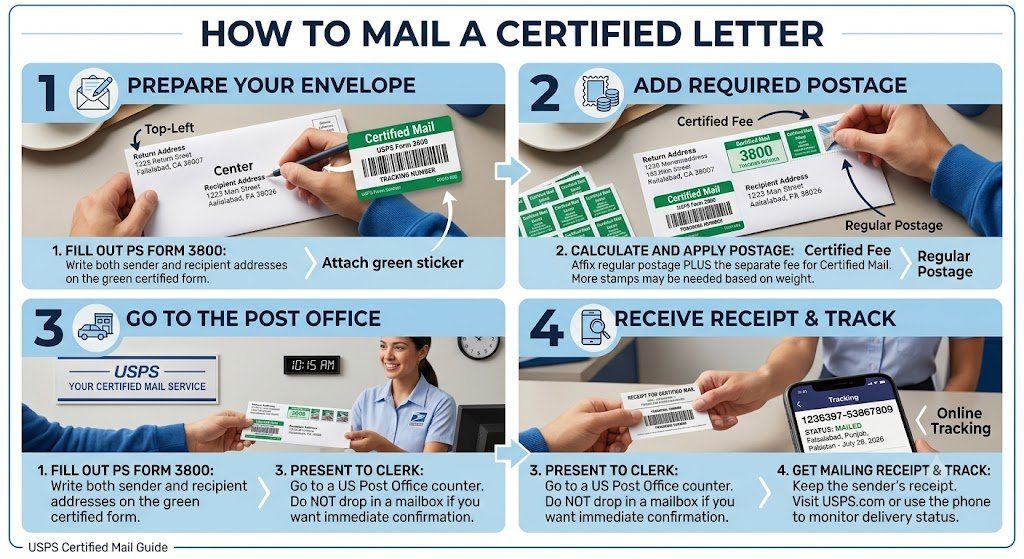
Step 3: Address the Envelope Clearly

Write the recipient’s address in the center.

Place your return address in the upper-left corner.

Use dark ink and block lettering for maximum readability.


Step 4: Obtain USPS Certified Mail Form 3800

One of the most important parts of learning how to mail a certified letter is understanding Form 3800.

This green-and-white sticker includes:

  • A barcode
  • A tracking number
  • USPS mailing information

The postal clerk can provide this form free of charge at the post office.


Step 5: Complete Form 3800

Fill out the required information.

Typically you’ll enter:

  • Recipient’s mailing address
  • Your return address (if required)
  • Additional mailing options if selected

Take your time to ensure everything matches the envelope exactly.


Step 6: Attach the Certified Mail Label

Peel the adhesive backing.

Place the barcode portion across the top edge of your envelope without covering the mailing address or postage area.

Proper placement allows USPS scanners to read the barcode throughout the delivery process.


Step 7: Decide Whether You Need Return Receipt

Many people confuse Certified Mail with Return Receipt.

They’re different services.

Certified Mail provides:

  • Mailing receipt
  • Tracking
  • Delivery record

A Return Receipt provides additional confirmation showing who accepted the letter and when it was delivered.

You can request:

  • Physical signature card
  • Electronic signature confirmation

Although optional, Return Receipt is commonly recommended for legal correspondence.


Step 8: Pay for Postage and Certified Mail Fees

Bring the completed envelope to your local USPS retail counter.

You’ll pay for:

  • Regular postage
  • Certified Mail fee
  • Optional services (if selected)

The postal clerk will process your mailing and provide an official receipt containing your tracking number.

Do not throw away this receipt.

It serves as your proof that the letter entered the USPS system.


Step 9: Track Your Certified Letter

After mailing, use the tracking number printed on your receipt.

Tracking allows you to monitor:

  • Acceptance
  • Processing
  • Transit
  • Arrival at destination
  • Delivery
  • Delivery attempts

This visibility is one of the primary reasons people choose Certified Mail over standard First-Class Mail.


How Long Does Certified Mail Take?

Delivery speed depends on several factors, including destination, weather, holidays, and local processing volumes.

Typical domestic delivery ranges from 2–5 business days, though times can vary.

Certified Mail travels with regular First-Class Mail while adding tracking and documentation throughout the process.


How Much Does It Cost to Mail a Certified Letter?

One of the most common questions after learning how to mail a certified letter is the cost. The total price depends on three factors:

  • Regular postage based on the size and weight of your letter
  • Certified Mail service fee
  • Optional extra services, such as Return Receipt or Restricted Delivery

If you’re sending only a standard letter, you’ll pay the normal First-Class postage plus the Certified Mail fee. Adding services like an electronic or mailed Return Receipt increases the total cost.

Tip: USPS occasionally updates postal rates, so check the current prices before mailing.


How to Track a Certified Letter

A major advantage of Certified Mail is its built-in tracking.

After your letter is accepted at the post office, you’ll receive a receipt with a unique tracking number. You can use that number to monitor every major step of the delivery process.

Tracking updates commonly include:

  • USPS accepted the letter
  • In transit
  • Arrived at a processing facility
  • Out for delivery
  • Delivered
  • Delivery attempted

Keep your receipt until the letter has been delivered and you no longer need proof of mailing.


What Is a Return Receipt?

Many people learning how to mail a certified letter choose to add a Return Receipt for extra documentation.

A Return Receipt provides proof of who accepted the letter and when it was delivered. Depending on the option you choose, you’ll receive either:

  • Electronic Return Receipt – A digital copy of the recipient’s signature.
  • Physical Return Receipt – A green postcard mailed back to you after delivery.

This service is especially useful when sending:

  • Court documents
  • Legal notices
  • Lease termination letters
  • Demand letters
  • Business contracts
  • Estate paperwork

While optional, it provides an additional layer of documentation if delivery must later be proven.


Certified Mail vs. Registered Mail

Although both services provide tracking, they serve different purposes.

Feature Certified Mail Registered Mail
Tracking Yes Yes
Proof of Mailing Yes Yes
Signature Confirmation Optional Usually included
Security Standard Highest USPS security
Best For Documents and letters High-value or irreplaceable items
Cost Lower Higher

If you’re mailing legal documents or important correspondence, Certified Mail is generally the most practical choice. Registered Mail is designed for valuable items that require maximum security during transit.


Certified Mail vs. Priority Mail

These services are often confused because both are offered by USPS.

Certified Mail focuses on documentation and proof of mailing.

Priority Mail focuses on faster shipping and includes tracking but does not automatically provide official proof of mailing for legal purposes.

If you need legal evidence that your letter was mailed and delivered, Certified Mail is the better option.


Common Mistakes to Avoid When Mailing a Certified Letter

Understanding how to mail a certified letter also means knowing what can go wrong.

Avoid these common mistakes:

  • Using an incorrect mailing address. Even a small typo can delay or prevent delivery.
  • Forgetting the return address. USPS may not be able to return the letter if it’s undeliverable.
  • Misplacing the Certified Mail label. The barcode must be visible and correctly positioned.
  • Throwing away your receipt. Your receipt is the official proof that the letter entered the USPS system.
  • Assuming Certified Mail requires a signature. A signature is generally obtained upon delivery, but additional services like Return Receipt provide extra documentation.
  • Skipping tracking. Check your tracking updates so you know when the letter has been delivered or if a delivery attempt failed.

Taking a few extra minutes to verify everything before mailing can save time and prevent unnecessary complications.


Expert Tips for Sending a Certified Letter

Whether you’re mailing one important document or sending Certified Mail regularly, these best practices can help:

  • Print addresses instead of handwriting whenever possible to improve readability.
  • Take a photo of the addressed envelope before mailing it.
  • Keep copies of every document you send.
  • Save your mailing receipt until the matter is fully resolved.
  • Track the shipment periodically instead of waiting for the recipient to respond.
  • Consider adding Return Receipt if the letter could become evidence in a legal or business dispute.
  • Mail early in the day to help your letter enter USPS processing sooner.

These simple habits create a clear paper trail and reduce the chance of avoidable problems.


Is Certified Mail Legally Recognized?

Yes. Certified Mail is widely used because it provides verifiable evidence that a letter was accepted by USPS and delivered or that delivery was attempted.

While the legal significance depends on the specific law, court, or agency involved, Certified Mail is commonly accepted as reliable documentation in situations involving:

  • Landlord-tenant disputes
  • Debt collection notices
  • Employment matters
  • Insurance claims
  • Government correspondence
  • Estate administration
  • Consumer protection issues

If a law or contract requires proof that notice was sent, Certified Mail is often one of the preferred mailing methods.


Conclusion

Knowing how to mail a certified letter gives you confidence when sending documents that truly matter. From preparing your envelope and completing the Certified Mail form to tracking your shipment and adding a Return Receipt when appropriate, the process is straightforward and provides valuable proof of mailing and delivery.

Before heading to the post office, double-check the recipient’s address, keep your mailing receipt in a safe place, and monitor the tracking number until the letter reaches its destination. These small steps can make a significant difference when you’re mailing legal notices, financial documents, contracts, or other important correspondence.


Frequently Asked Questions (FAQ)

1. Can I mail a certified letter from my home?

Yes. You can prepare your envelope and complete the Certified Mail label before mailing, but USPS procedures may vary depending on how you submit the item. Many people choose to visit a post office to ensure the letter is properly accepted and receive an official mailing receipt.


2. Does Certified Mail require a signature?

Certified Mail generally includes a record of delivery, and a signature may be collected upon delivery depending on USPS procedures. If you need a copy of the recipient’s signature for your records, adding a Return Receipt provides that additional documentation.


3. How long should I keep my Certified Mail receipt?

Keep your receipt until your letter has been delivered and you no longer need proof of mailing. For legal or financial matters, many people retain the receipt along with copies of the mailed documents until the issue is fully resolved.


4. Can I send packages using Certified Mail?

Certified Mail is intended for eligible mail classes containing documents and correspondence. If you’re mailing a package, review USPS mailing options to determine whether Certified Mail is available for your shipment and whether another service better fits your needs.


5. What happens if no one is available to receive my Certified Mail?

If delivery cannot be completed, USPS typically leaves a notice and may attempt delivery again or hold the item for pickup at the local post office for a limited time. If the letter remains unclaimed, it is generally returned to the sender.


By following this guide on how to mail a certified letter, you’ll be prepared to send important documents with confidence, maintain a reliable record of mailing, and track your letter from acceptance to delivery. Whether you’re handling personal, legal, or business correspondence, Certified Mail offers an extra level of accountability that standard mail cannot provide.

- Advertisement -spot_img

More articles

LEAVE A REPLY

Please enter your comment!
Please enter your name here

- Advertisement -spot_img

Latest article